
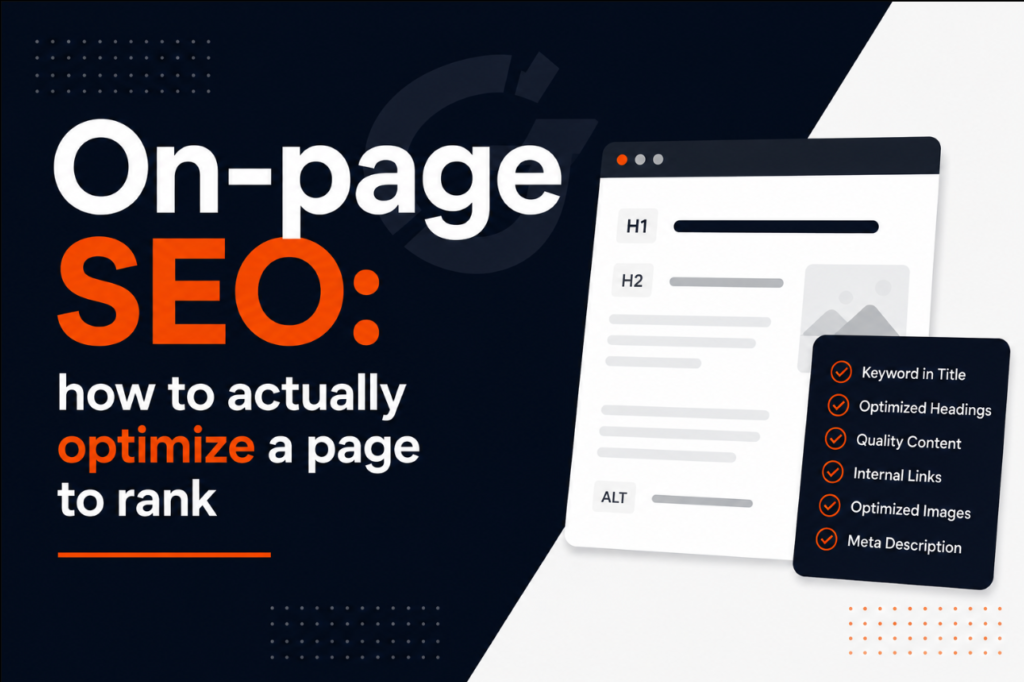
Most on-page SEO guides are a checklist. Title tag, meta description, headers, alt text, internal links, done. Tick the boxes and the rankings show up.
They don’t show up. I’ve cleaned up enough sites behind other agencies to tell you that a perfect on-page checklist on a broken site does close to nothing. The checklist isn’t wrong. It’s just missing the part that matters: what to fix first, what barely moves the needle, and how the pieces work together as a system instead of a to-do list.
This guide covers all the on-page SEO techniques you’d expect, and I’ll be thorough about it. But I’m going to give them to you in the order they actually matter, based on rebuilding on-page for sites in some of the most competitive niches there are. If you want a checklist you can skim, there’s one at the end. If you want to understand why the checklist works, read the whole thing.
What on-page SEO actually is
On-page SEO is the practice of optimizing the content and HTML of a page so search engines understand it and rank it, and so the person who lands on it actually does what you want. That second half gets left out of most definitions, and leaving it out is why a lot of “optimized” pages rank and still make no money.
On-page SEO refers to everything you control on the page itself: the content, the title tag, the meta description, the headers, the internal links, the URL, the structured data, the images. Everything Google reads when it crawls the page, and everything a human reads when they land on it.
That’s different from off-page SEO, which is everything happening away from your page. Backlinks, brand mentions, citations, reviews. On-page and off-page SEO work together, but they’re not the same job, and you don’t need equal amounts of both. For most sites, on-page is where the fastest wins are hiding, because it’s the stuff you fully control and it’s usually the stuff that’s broken.
Here’s the mental model I want you to hold for the rest of this: a page is a signal to search engines about what it’s about and how good it is. On-page SEO is you making that signal clean, strong, and impossible to misread. Off-page is the rest of the internet vouching for you. You can’t control the vouching directly. You can control the signal completely. So control it.
Why on-page SEO is important, and where most people waste their time
On-page SEO is important because it’s the only part of the ranking equation you own outright. You don’t need anyone’s permission, you don’t need to earn a link, you don’t need budget approved. You can fix a title tag this afternoon.
But here’s where people burn time. They obsess over the small stuff, keyword density, exact-match keywords in the first sentence, the meta description length down to the character, and ignore the big stuff that actually moves rankings. Meta description length has basically no direct ranking impact. It affects click-through, which matters, but people treat it like a ranking lever and it isn’t one.
Meanwhile the things that genuinely move rankings, whether the page actually satisfies the search intent, whether the content is better than what’s ranking, whether the page is internally linked so Google can find and understand it, get less attention because they’re harder and less checkbox-able.
So before the techniques, the priority order. This is how I’d rebuild on-page SEO on a site from scratch:
- Search intent match. Does the page answer what the searcher actually wants?
- Content quality and depth. Is it better than what’s ranking now?
- Internal linking and site structure. Can Google find and understand the page?
- Title tag and H1. Are the strongest relevance signals clear?
- URL, headers, and on-page structure. Is the page easy to parse?
- Technical on-page: schema, page speed, image optimization.
- Meta description and the polish layer.
Notice the checklist stuff most guides lead with, meta descriptions, alt text, is at the bottom. That’s not because it doesn’t matter. It’s because doing it perfectly on a page that fails at intent match is polishing a car with no engine.
Let me go through each layer.
Search intent: the on-page factor everyone skips
If you get one thing right, get this. Search intent is what the person actually wants when they type a query. Match it and everything else gets easier. Miss it and no amount of optimization saves you.
Every keyword has an intent behind it. Someone searching “on page seo” wants to learn how to do it. Someone searching “on page seo checklist” wants a scannable list. Someone searching “on page seo services” wants to hire someone. Same topic, three completely different pages required. If you build a services page and try to rank it for “how to do on page seo,” you lose, because the intent is wrong and Google knows it.
Before you write or optimize a single page, go look at what’s already ranking for your target keyword. The top 10 results are Google telling you, out loud, what it thinks the intent is. If they’re all long guides, a short page won’t rank. If they’re all listicles, your essay won’t rank. If they’re all product pages, your blog post won’t rank. Match the format the SERP is rewarding, then beat it on quality.
This is the step that separates people who rank from people who optimize. Optimizing the wrong page type is just doing the wrong thing neatly.
Content: on-page SEO is mostly just being the best answer
Once the intent is right, the content has to be the best answer to the query on the internet. Not tied for best. Best. Because Google’s whole job is showing the best result, and if you’re second-best, second place on page one still gets a fraction of the clicks the top spot does.
What “best” means in practice:
Cover the topic completely. Look at what the ranking pages cover, then cover it better and cover what they missed. Tools like Contadu, Surfer, and Clearscope will give you the terms and subtopics the ranking pages share. That’s not a keyword-stuffing list. It’s a map of what a complete answer looks like for this query. Use it to make sure you’re not missing anything, not to hit a density target.
Do keyword research properly. Your primary keyword, your secondary keywords, and the related terms people actually search. But incorporating keywords is not the point of content. Answering the question is the point. The keywords are how you signal what you’re answering. Work them in where they fit naturally and stop forcing them where they don’t. Keyword stuffing is a 2012 tactic that now actively hurts you.
Write for the person, then optimize for the engine. In that order. High-quality content that a human wants to read is what gets links, gets shared, and keeps people on the page, which are all signals to search engines that the content is valuable. Write something worth ranking and the optimization is the easy part.
Make it easy to read. Short paragraphs. Clear subheads. Lists where they help. If the page is a wall of text, people bounce, and bounce is a signal too. Readable and skimmable isn’t a nicety, it’s part of the optimization.
Site structure and internal links: the on-page work almost nobody does right
Here’s where I make most of my money cleaning up after other agencies. Internal linking and site structure are the most underrated on-page factors that exist, and they’re broken on the majority of sites I audit.
Internal links do two things. They pass authority around your site, and they help Google discover and understand your pages. A page with no internal links pointing to it is an orphan. Google struggles to find it, struggles to understand where it fits, and ranks it accordingly, which is to say, badly.
I took over an MSO site once where every single product page was orphaned. Zero internal links. The previous agency had spent six figures over a year and non-branded rankings were declining the whole time. We fixed the internal linking, fixed the structure, built out proper category and collection pages, and the site went from 24,000 ranking keywords to 56,800 in six months. It’s past 130,000 now. Same products. Same domain. The content was mostly already there. It just wasn’t connected, so Google couldn’t see it properly. (We wrote that one up in our SEO case studies if you want the full breakdown.)
What good internal linking looks like:
Link from high-authority pages to the pages you want to rank. Your homepage and your most-linked pages have authority. Point some of it where you need it.
Use descriptive anchor text. Not “click here.” The anchor text tells Google what the linked page is about, so use words that describe the destination. If you’re linking to a page about on-page SEO, the anchor should say something about on-page SEO.
Build a logical site structure. Categories, subcategories, and pages that nest in a way that makes sense. Every important page should be reachable in a few clicks from the homepage. If it’s buried ten clicks deep, it’s effectively invisible.
This is unglamorous work. It’s also, in my experience, the single highest-ROI on-page work you can do on an established site that already has content. If you have a lot of pages and weak internal linking, fixing it is often the fastest ranking win available to you.
Title tags and H1s: your strongest on-page relevance signals
Now the stuff most guides start with. The title tag is one of the strongest on-page signals you have, so treat it like it matters.
The title tag is what shows in the search results as the clickable headline. It tells Google and the searcher what the page is about. Put your target keyword in it, ideally near the front, and write it so a human actually wants to click. Both jobs matter. A keyword-perfect title nobody clicks is a wasted title, because click-through is itself a ranking signal on the results page.
The H1 is the main heading on the page. One H1 per page. It should contain your primary keyword or a close variation. Think of the title tag as what Google shows in search and the H1 as the headline on the page itself. They can differ, and often should, the title tag optimized for the click, the H1 optimized for the reader who already clicked.
Your other headers, the H2s and H3s, structure the page and give you natural places to work in secondary keywords and related terms. Use them to organize the content logically. A page with clear header structure is easier for Google to parse and easier for a human to skim. Don’t force keywords into every header. Force clarity into every header, and let the keywords land where they fit.
URLs, headers, and page structure
Keep URLs short, readable, and descriptive. A URL like /on-page-seo tells Google and the user what the page is about. A URL like /page?id=8837&cat=12 tells them nothing. Include your target keyword, keep it clean, drop the stop words. This matters more on large sites where bloated, parameter-heavy URLs pile up and start causing crawl and duplicate-content problems.
Structure the page so it’s easy to parse. Logical header hierarchy, short paragraphs, lists where they earn their place, a clear flow from top to bottom. The easier a page is for a human to read, the easier it is for Google to understand, because Google is increasingly good at evaluating the same things a human would.
Technical on-page: schema, speed, and images
This is the layer that’s genuinely technical, and it’s where a lot of on-page potential quietly leaks away.
Structured data (schema markup) is code you add to a page to explicitly tell search engines what the content is. A product, an article, a review, a business, an FAQ. Schema doesn’t directly boost rankings, but it makes you eligible for rich results, the star ratings, FAQ dropdowns, and other enhanced listings that eat up SERP real estate and pull clicks. On eCommerce and local sites especially, correct schema is worth the effort. Wrong or missing schema is one of the most common problems I find on audits, right up there with orphaned pages.
Page speed matters, for rankings and for conversions. A slow page loses visitors before they read anything, and Google factors load speed into rankings, especially on mobile. Compress your images, clean up bloated code, and don’t let a beautiful design tank your load time. I’ve seen gorgeous sites that convert terribly because they take six seconds to load. Pretty is not the goal. Fast and functional is.
Image optimization is two things. Compress the file so it loads fast, and write descriptive alt text so search engines understand what the image is (and so it’s accessible to people using screen readers). Use descriptive file names too, product-name.jpg beats IMG_4471.jpg. Alt text isn’t a place to stuff keywords. It’s a place to describe the image accurately, which sometimes includes a keyword and often doesn’t.
Meta descriptions and the polish layer
The meta description is the snippet under your title in the search results. Here’s the honest truth most guides won’t tell you: it’s not a direct ranking factor. Google often rewrites it anyway.
So why bother? Because it affects click-through rate, and click-through does matter. A compelling meta description that includes the target keyword and gives the searcher a reason to click will pull more traffic than a generic one. Write it for the click, include the keyword because Google bolds it when it matches the query, and keep it to around 150-160 characters so it doesn’t get cut off.
This is the polish layer. It’s real, it’s worth doing, and it belongs exactly where it is: at the end, after the stuff that actually determines whether you rank in the first place. Optimizing meta descriptions on a page that fails at intent and content is rearranging deck chairs.
On-page vs off-page SEO: where on-page stops
Everything so far is on-page, the stuff you control on the page. Off-page SEO is the rest: backlinks from other sites, brand mentions, citations, reviews. Off-page is Google asking “does the rest of the internet think this page is credible?”
You need both. But the order matters, and I see people get it backwards constantly. They go chasing links to a page that isn’t internally linked, has weak content, and misses the search intent. That’s pouring authority into a bucket with holes in it. Get the on-page right first, so that when the links do come, they’re pointing at a page that’s actually built to rank. On-page is the foundation. Off-page is the amplifier. Amplifying a broken signal just gives you a louder broken signal.
On-page SEO checklist
Here’s the scannable version, in priority order. Work top to bottom.
- Match search intent. Look at what’s ranking and match the page type and format before anything else.
- Make the content the best answer on the internet for the query. Cover the topic completely, write for humans, keep it readable.
- Do proper keyword research. Primary keyword, secondary keywords, related terms. Work them in naturally, never stuff.
- Fix internal linking. No orphaned pages, descriptive anchor text, authority flowing to the pages you want to rank.
- Build logical site structure. Important pages reachable in a few clicks from the homepage.
- Optimize the title tag. Target keyword near the front, written for the click.
- Set one clear H1 per page with the primary keyword.
- Structure headers (H2s, H3s) logically, with secondary keywords where they fit.
- Clean up the URL. Short, readable, keyword-included, no bloat.
- Add correct structured data (schema) for your page type.
- Fix page speed. Compress images, clean the code, test on mobile.
- Optimize images. Compressed files, descriptive file names, accurate alt text.
- Write a meta description for click-through. Include the keyword, 150-160 characters.
- Run it through Google Search Console after publishing and watch what happens.
The part that actually matters
On-page SEO isn’t complicated. It’s just that most people do it in the wrong order and spend their energy on the parts that photograph well instead of the parts that work.
Get the intent right. Make the content the best answer. Connect your pages so Google can see them. Then optimize the details. Do it in that order and you’ll beat competitors who have a prettier checklist and a broken foundation, which describes most of them.
If you’ve got a site with a lot of content that isn’t ranking the way it should, the problem is usually not that you need more content. It’s that what you have is disconnected, misaligned with intent, or sitting on a technical foundation that’s quietly holding everything back. That’s fixable, and it’s usually faster to fix than people expect.
That’s the work we do. If you want to know what’s actually holding your pages back, an SEO audit will tell you exactly where the problems are and what to fix first. Or if you’d rather just have it handled, that’s what our SEO services are for.